
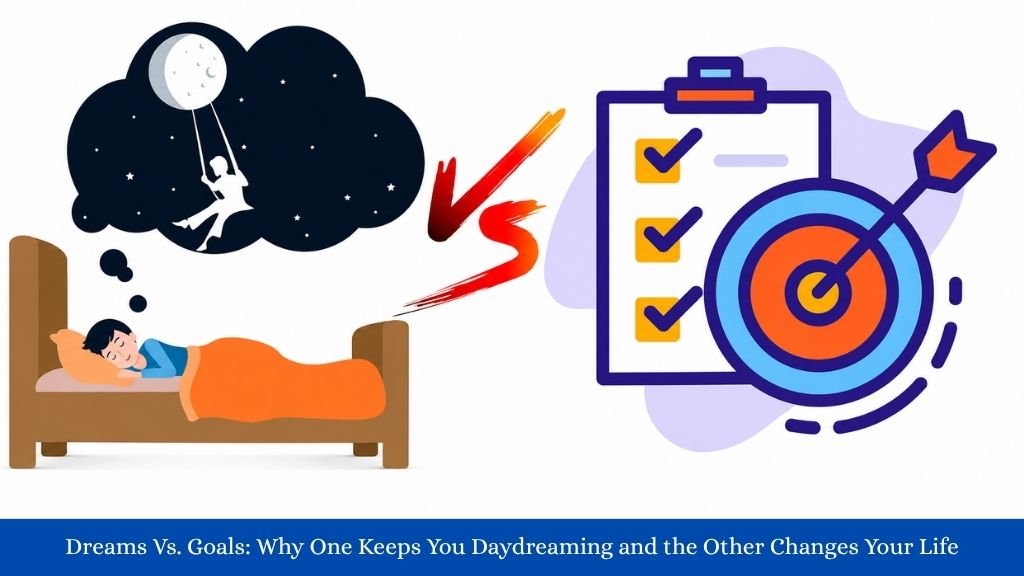
A goal and a dream are not the same thing. Dreams fill your heart and thoughts while goals dominate the current reality. Many people take a dream and a goal to be too often confused with each other. They want to fulfill a dream. You make your dreams come true by setting goals for each one and then acting to achieve them.
Goals and dreams are both necessary, but they differ greatly from one another. A dream is a potential result. A goal is a future activity. You can see where you want to go in your dreams. They serve as your life’s roadmap. A dream is unachievable. Goals can be accomplished by taking action. A vision of a future goal is necessary for dreams. To achieve your goals, you must take steps that will make your dreams come true.
The Differences Between Dreams and Goals
Here are several major differences between dreams and goals:
- Continuous Efforts: You have to work continuously toward your goals. Action is necessary to achieve goals. Even when you are asleep, dreams might occur without you having to do anything.
- Deadlines: There must be a deadline for goals. Dreams are endless. A lot of people pursue their dream throughout their lives without ever succeeding.
- Price: Goals have a cost, but daydreaming is free. Sweat, money, time, and effort. How are you going to fund your objectives?
- Based on Reality: Objectives are grounded in reality. It’s unlikely that you will become Superman, even if that is your dream. What you can truly achieve is what your goals are about. They are based on the facts of this world. Objectives should be high but not supernatural or something beyond this world.
- The End: There is a finish line for goals. Dreams don’t have to end. Dreams are endless. They do not need any conclusion. Objectives need to have a clear result.
- Inspiration: One can be inspired by his dreams, but life can be transformed through goals only. Dreams can inspire you. You may be motivated by them. However, goals have the power to change your life.
- Focus: Objectives need to be focused. Dreams don’t. Dreams can be moving, constantly shifting ideas. Goals need to be very specific. They need to be precise and on your mind constantly. All you need to create dreams is your imagination. Dreaming is simple.
These are the major differences between dreams and goals. Make sure you do not let your dreams become your objectives.
Here is an ideal framework, referred to as “WISE goals.” This framework consists of four questions and is intended to boost your motivation and raise your chances of realizing your goals:
W: Answer the Question
Can you accomplish this goal on your own, without the help of other people? Reframe if the answer is negative. Instead of aiming for $2 million in sales, try to make 40 qualified discovery calls each month.
I: inspire new abilities
Well-crafted objectives inspire the skills necessary to achieve your goal.
Financial literacy, self-discipline, and decision-making abilities are developed through building wealth through regular, self-directed activity and meticulous planning. Without that preparation, dreams that come true out of the blue leave the dreamer not able to deal with their good fortune.
S: Particular action
Although dreams are never certain, pursuing your objective should increase their likelihood. Locke and Latham’s research shows that explicit goals perform better than vague ones. This process should include the WISE framework, just like the SMART goals.
E: Enough
If you work hard enough and put years of effort into achieving this aim, and the objective is sustainable if the process includes learning, discipline, and growth, it has genuine value. You have made your motivation dependent on something outside of your control if you are only pursuing it because you think it will produce a certain result.
WISE Objectives Raise the Standard
Because WISE goals eliminate the escape that outcome-based goals offer, they raise the bar for personal accountability. There is always someone or something to blame when you fail to close $2 million in new revenue: a competitor got lucky, the market was weak, or a significant deal fell through.
The external factor increases the blame. But there’s nowhere to hide when your objective is to make 40 quality discovery calls. You either worked hard or you didn’t. Excuses are structurally impossible with WISE goals.