
The software architecture known as “microservices” divides an application into smaller, independent components called services. Each service takes care of a single task and uses simple APIs to connect to the others. This enables the teams to develop, implement, and expand each service without changing the whole system.
Businesses use this paradigm to expedite the deployment of applications. Even small changes in a monolithic system mean rebuilding the entire application, which causes downtime and slows down development. Teams can easily update individual services with microservices, cutting down on bottlenecks and providing users with new features more quickly. The article will explain the fundamentals of microservices security and the recommended practices for a successful security architecture.
What is Microservices Security?
“Microservices” refers to the techniques and controls that protect individual services, their communication channels, and the architecture as a whole from attacks and abuse. Microservices require multi-layered security across code, network, infrastructure, and runtime as they work as separate, loosely linked components. The key objectives of microservices security include sensitive data protection, secure communication, prevention of unwanted access, and preserving the integrity of each service and its dependencies.
Best Practices for Microservices Architecture
Microservices require a proactive, multi-layered security model. Compared to monolithic systems with centralized controls, distributed services add more access points, complexity, and variability. The design, development, deployment, and runtime stages are all included in effective microservices security, and each layer is crucial for preventing exploitation and misconfiguration.
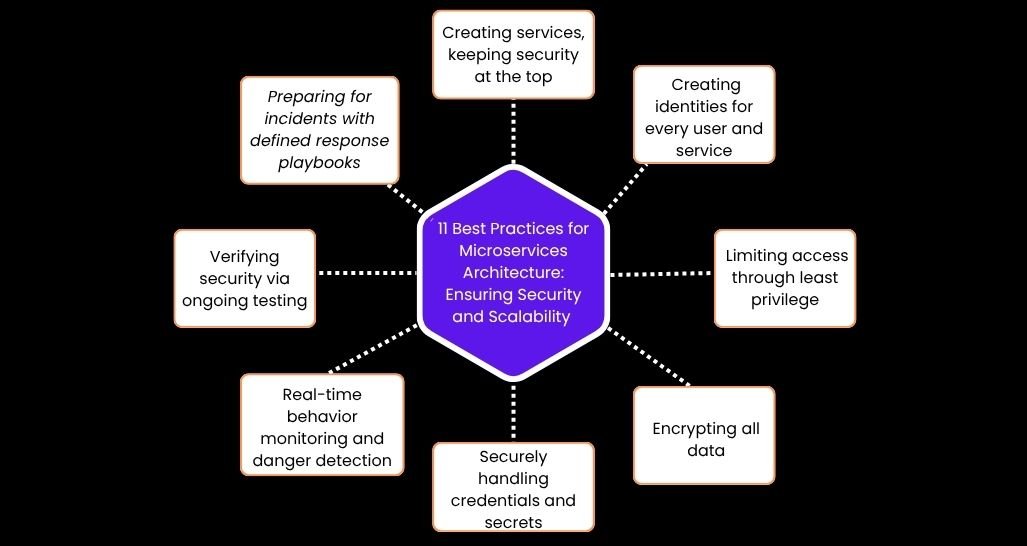
Here are the Best Practices for Microservices Architecture that ensure a strong security posture:
- Creating services, keeping security at the top
Teams can easily minimize the technological debt and prevent future patching of predictable problems by including security in the design process. The threat modeling encourages early mapping of prospective attackers, access sites, and sensitive functions. By mandating input validation and output encoding, teams shield their services from injection attacks and cross-site scripting, particularly when services exchange user-generated data.
- Creating identities for every user and service
Before interacting with another component, every person, system, and service should be recognizable thanks to reliable authentication. In distributed systems, it includes external-facing APIs and internal service communication. The infrastructure for cross-environment identity verification is offered by protocols like OAuth 2.0, JWT, and mTLS. Teams can automate and scale identity enforcement within service mesh implementations such as Istio.
- Limiting access through least privilege
Access controls ensure that a service or user has the minimal privileges required to carry out its operations. Both attribute-based access control (ABAC) and role-based access control (RBAC) provide organized methods of enforcement. Privilege creep, which happens when services change and permissions are not checked, is avoided via regular policy reviews.
- Encrypting all data
Encryption protects sensitive data, independent of its location or mode of transportation. While encryption at rest protects storage media from unwanted access, encryption in transit uses TLS to prevent interception during communication.
When sensitive data travels across network boundaries or resides in multi-tenant systems, these measures are crucial.
- Securely handling credentials and secrets
Attacks often target significant data like tokens and API keys. Whether in code or containers, storing them in plain text leaves entire systems vulnerable to hacking. Teams can maintain uniform security standards across microservices through a centralized secrets manager, supporting encryption, access logging, and rotation.
- Securing and auditing third-party components
Each dependency introduces potential API vulnerabilities. Teams should be able to automatically recognize third-party code as untrusted, regardless of whether it’s an open-source library or a base container image. While image signing and source validation stop the inadvertent insertion of malicious code, software composition analysis tools assist teams in identifying known vulnerabilities.
- Managing request volumes and resource utilization
Teams can minimize abuse and lessen denial-of-service attacks by implementing rate limitation and throttling. To limit the quantity of permitted requests per client or IP address, teams implement these limitations via API gateways, reverse proxies, or service mesh policies. By limiting CPU, memory, or disk utilization, resource limitations also contain the explosion radius of vulnerable workloads.
- Real-time behavior monitoring and danger detection
Real-time visibility is vital for detecting unauthorized behavior and understanding situations. Security teams can reconstruct events and react promptly by recording login attempts, data access, and configuration modifications. By spotting container drift, odd processes, or lateral movement between services, runtime threat detection techniques improve observability.
- Verifying security via ongoing testing
Security needs constant validation; it’s not a one-time activity on a checklist. Static code analysis, integration-level testing, and container scans are integrated into CI/CD pipelines by organizations. By highlighting business logic errors or presumptions that automated technologies frequently overlook, red team exercises and penetration testing support automated operations.
- Preparing for incidents with defined response playbooks
Incidents can occur even with robust preventive mechanisms. Keeping up a tried-and-true response plan guarantees that a business reacts promptly and systematically. Unplanned incidents can be turned into learning opportunities to prevent recurring failures with the use of clear roles, runbooks, escalation paths, and post-incident reviews.
- Protecting the software pipeline and supply chain
Because they preserve broad access to code, secrets, and environments, CI/CD pipelines and build systems are high-value targets. By enforcing signed commits, checking build artifacts, and limiting build agent rights, the team can reduce the danger of tampering. Monitoring an SBOM reveals exposure to unreliable or susceptible components.